
Bridge Card Deck Design Guide
This guide is for creators designing custom bridge-size playing cards for traditional card games, clubs, tournaments, education, or refined brand decks. Like poker cards, bridge cards demand clarity and consistency, but with different physical and usability priorities.
This guide explains both what specifications to follow and why bridge cards are designed the way they are.
1. What are Bridge Cards?
4. Number Cards (Pips)
7. File Setup & Print Req.
10. Bridge Size Is Best For
2. Bridge Card Specifications
5. Card Back Design
8. Paper Stock & Finish
11. Ready to Print?
3. Card Face Design
6. Colour Considerations
9. Common Design Mistakes

1. What are Bridge Cards?
Bridge cards are a slimmer alternative to poker cards, traditionally used for:
-
Bridge
-
Whist
-
Euchre
-
Hearts, Spades, and similar trick-taking games
-
Club and tournament play
Their narrower width allows players to comfortably hold more cards, which is essential for many classic games.
2. Standard Bridge Card Specifications
Card Size
- Standard size: 57 × 88.8 mm (2.25 × 3.5 inches) – View Full Advanced Card Size Guide
- Corner radius: Rounded (industry standard)
Card Count
Typical configurations:
-
52 cards (standard deck)
-
54 cards (with 2 Jokers)
-
Optional extra cards (rules, club branding, instruction cards)
For competitive or educational decks, consistency is critical.
Bridge Card Deck
Design Guide
This guide is for creators designing custom bridge-size playing cards for traditional card games, clubs, tournaments, education, or refined brand decks. Like poker cards, bridge cards demand clarity and consistency, but with different physical and usability priorities.
This guide explains both what specifications to follow and why bridge cards are designed the way they are.
1. What are Bridge Cards?
2. Bridge Card Specifications
3. Card Face Design
4. Number Cards (Pips)
5. Card Back Design
6. Colour Considerations
7. File Setup & Print Req.
8. Paper Stock & Finish
9. Common Design Mistakes
10. Bridge Size Is Best For
11. Ready to Print?
1. What are Bridge Cards?
Bridge cards are a slimmer alternative to poker cards, traditionally used for:
-
Bridge
-
Whist
-
Euchre
-
Hearts, Spades, and similar trick-taking games
-
Club and tournament play
Their narrower width allows players to comfortably hold more cards, which is essential for many classic games.
2. Standard Bridge Card Specifications
Card Size
- Standard size: 57 × 88.8 mm (2.25 × 3.5 inches) – View Full Advanced Card Size Guide
- Corner radius: Rounded (industry standard)
Card Count
Typical configurations:
-
52 cards (standard deck)
-
54 cards (with 2 Jokers)
-
Optional extra cards (rules, club branding, instruction cards)
For competitive or educational decks, consistency is critical.
Bridge Card Deck Design Guide
This guide is for creators designing custom bridge-size playing cards for traditional card games, clubs, tournaments, education, or refined brand decks. Like poker cards, bridge cards demand clarity and consistency, but with different physical and usability priorities.
This guide explains both what specifications to follow and why bridge cards are designed the way they are.
1. What are Bridge Cards?
2. Bridge Card Specifications
3. Card Face Design
4. Number Cards (Pips)
5. Card Back Design
6. Colour Considerations
7. File Setup & Print Req.
8. Paper Stock & Finish
9. Common Design Mistakes
10. Bridge Size Is Best For
11. Ready to Print?
1. What are Bridge Cards?
Bridge cards are a slimmer alternative to poker cards, traditionally used for:
-
Bridge
-
Whist
-
Euchre
-
Hearts, Spades, and similar trick-taking games
-
Club and tournament play
Their narrower width allows players to comfortably hold more cards, which is essential for many classic games.
2. Standard Bridge Card Specifications
Card Size
- Standard size: 57 × 88.8 mm (2.25 × 3.5 inches) – View Full Advanced Card Size Guide
- Corner radius: Rounded (industry standard)
Card Count
Typical configurations:
-
52 cards (standard deck)
-
54 cards (with 2 Jokers)
-
Optional extra cards (rules, club branding, instruction cards)
For competitive or educational decks, consistency is critical.
3. Card Face Design
Indices (Numbers & Suits)
Because bridge cards are narrower, index clarity is even more important than with poker cards.
Best practices:
-
Top-left and bottom-right placement
-
Clean, highly legible fonts
-
Strong contrast against the background
Avoid:
-
Oversized decorative fonts
-
Crowded corner artwork
-
Low-contrast colour schemes
Suits
Standard suits remain:
-
Hearts
-
Diamonds
-
Clubs
-
Spades
Design considerations:
-
Maintain classic suit proportions
-
Keep red/black distinction obvious
-
Avoid overly thin line weights that may disappear at small sizes
Bridge players expect familiarity—subtle refinement works better than radical reinvention.
Court Cards (J, Q, K)
Court cards should prioritise recognition over novelty.
Recommendations:
-
Mirrored (two-way) layouts
-
Clear facial features and symbols
-
Consistent illustration style across all courts
Highly abstract courts may reduce playability, especially for older players.
3. Card Face Design
Indices (Numbers & Suits)
Because bridge cards are narrower, index clarity is even more important than with poker cards.
Best practices:
-
Top-left and bottom-right placement
-
Clean, highly legible fonts
-
Strong contrast against the background
Avoid:
-
Oversized decorative fonts
-
Crowded corner artwork
-
Low-contrast colour schemes
Suits
Standard suits remain:
-
Hearts
-
Diamonds
-
Clubs
-
Spades
Design considerations:
-
Maintain classic suit proportions
-
Keep red/black distinction obvious
-
Avoid overly thin line weights that may disappear at small sizes
Bridge players expect familiarity—subtle refinement works better than radical reinvention.
Court Cards (J, Q, K)
Court cards should prioritise recognition over novelty.
Recommendations:
-
Mirrored (two-way) layouts
-
Clear facial features and symbols
-
Consistent illustration style across all courts
Highly abstract courts may reduce playability, especially for older players.
3. Card Face Design
Indices (Numbers & Suits)
Because bridge cards are narrower, index clarity is even more important than with poker cards.
Best practices:
-
Top-left and bottom-right placement
-
Clean, highly legible fonts
-
Strong contrast against the background
Avoid:
-
Oversized decorative fonts
-
Crowded corner artwork
-
Low-contrast colour schemes
Suits
Standard suits remain:
-
Hearts
-
Diamonds
-
Clubs
-
Spades
Design considerations:
-
Maintain classic suit proportions
-
Keep red/black distinction obvious
-
Avoid overly thin line weights that may disappear at small sizes
Bridge players expect familiarity—subtle refinement works better than radical reinvention.
Court Cards (J, Q, K)
Court cards should prioritise recognition over novelty.
Recommendations:
-
Mirrored (two-way) layouts
-
Clear facial features and symbols
-
Consistent illustration style across all courts
Highly abstract courts may reduce playability, especially for older players.
4. Number Cards (Pips)
Number cards must be readable at a glance.
Best practices:
-
Traditional pip layouts
-
Even spacing adapted to the narrower width
-
Adequate margins from card edges
Because hands are often held close together, clutter becomes noticeable quickly.
5. Card Back Design
Symmetry
Bridge card backs should be fully symmetrical.
This ensures:
-
Fair play
-
No orientation cues
-
Acceptance in formal game settings
One-way backs are generally inappropriate for bridge decks.
Borders vs Full Bleed
Bordered backs are strongly recommended:
-
Help disguise cutting tolerances
-
Preserve a traditional aesthetic
-
Improve perceived quality in club play
Full-bleed backs are possible but require precise bleed control.
4. Number Cards (Pips)
Number cards must be readable at a glance.
Best practices:
-
Traditional pip layouts
-
Even spacing adapted to the narrower width
-
Adequate margins from card edges
Because hands are often held close together, clutter becomes noticeable quickly.
5. Card Back Design
Symmetry
Bridge card backs should be fully symmetrical.
This ensures:
-
Fair play
-
No orientation cues
-
Acceptance in formal game settings
One-way backs are generally inappropriate for bridge decks.
Borders vs Full Bleed
Bordered backs are strongly recommended:
-
Help disguise cutting tolerances
-
Preserve a traditional aesthetic
-
Improve perceived quality in club play
Full-bleed backs are possible but require precise bleed control.
4. Number Cards (Pips)
Number cards must be readable at a glance.
Best practices:
-
Traditional pip layouts
-
Even spacing adapted to the narrower width
-
Adequate margins from card edges
Because hands are often held close together, clutter becomes noticeable quickly.
5. Card Back Design
Symmetry
Bridge card backs should be fully symmetrical.
This ensures:
-
Fair play
-
No orientation cues
-
Acceptance in formal game settings
One-way backs are generally inappropriate for bridge decks.
Borders vs Full Bleed
Bordered backs are strongly recommended:
-
Help disguise cutting tolerances
-
Preserve a traditional aesthetic
-
Improve perceived quality in club play
Full-bleed backs are possible but require precise bleed control.
6. Colour Considerations
-
Use solid, high-contrast colours for faces
-
Avoid ultra-light colours for indices
Black backgrounds look striking but may:
-
Show edge wear faster
-
Reveal handling marks
7. File Setup & Print Requirements
Bleed
-
Include bleed on all sides (3mm) – View Full Advanced Card Size Guide
-
Extend background elements fully into bleed
Never place:
- Text
- Indices
- Important artwork near the trim edge.
Safe Zone
Keep all critical elements comfortably inside the safe zone to prevent trimming issues.
Resolution & Colour Mode
-
Minimum 300 DPI
-
CMYK colour mode
Convert colours carefully: bright RGB colours may print duller.
6. Colour Considerations
-
Use solid, high-contrast colours for faces
-
Avoid ultra-light colours for indices
Black backgrounds look striking but may:
-
Show edge wear faster
-
Reveal handling marks
7. File Setup & Print Requirements
Bleed
-
Include bleed on all sides (3mm) – View Full Advanced Card Size Guide
-
Extend background elements fully into bleed
Never place:
- Text
- Indices
- Important artwork near the trim edge.
Safe Zone
Keep all critical elements comfortably inside the safe zone to prevent trimming issues.
Resolution & Colour Mode
-
Minimum 300 DPI
-
CMYK colour mode
Convert colours carefully: bright RGB colours may print duller.
6. Colour Considerations
-
Use solid, high-contrast colours for faces
-
Avoid ultra-light colours for indices
Black backgrounds look striking but may:
-
Show edge wear faster
-
Reveal handling marks
7. File Setup & Print Requirements
Bleed
-
Include bleed on all sides (3mm) – View Full Advanced Card Size Guide
-
Extend background elements fully into bleed
Never place:
- Text
- Indices
- Important artwork near the trim edge.
Safe Zone
Keep all critical elements comfortably inside the safe zone to prevent trimming issues.
Resolution & Colour Mode
-
Minimum 300 DPI
-
CMYK colour mode
Convert colours carefully: bright RGB colours may print duller.
8. Paper Stock & Finish
Common Choices
- Smooth finish: Clean look, softer handling
- Linen or textured finish: Improved grip, traditional feel
Consider:
-
How often the deck will be shuffled
-
Whether it’s for gameplay or display
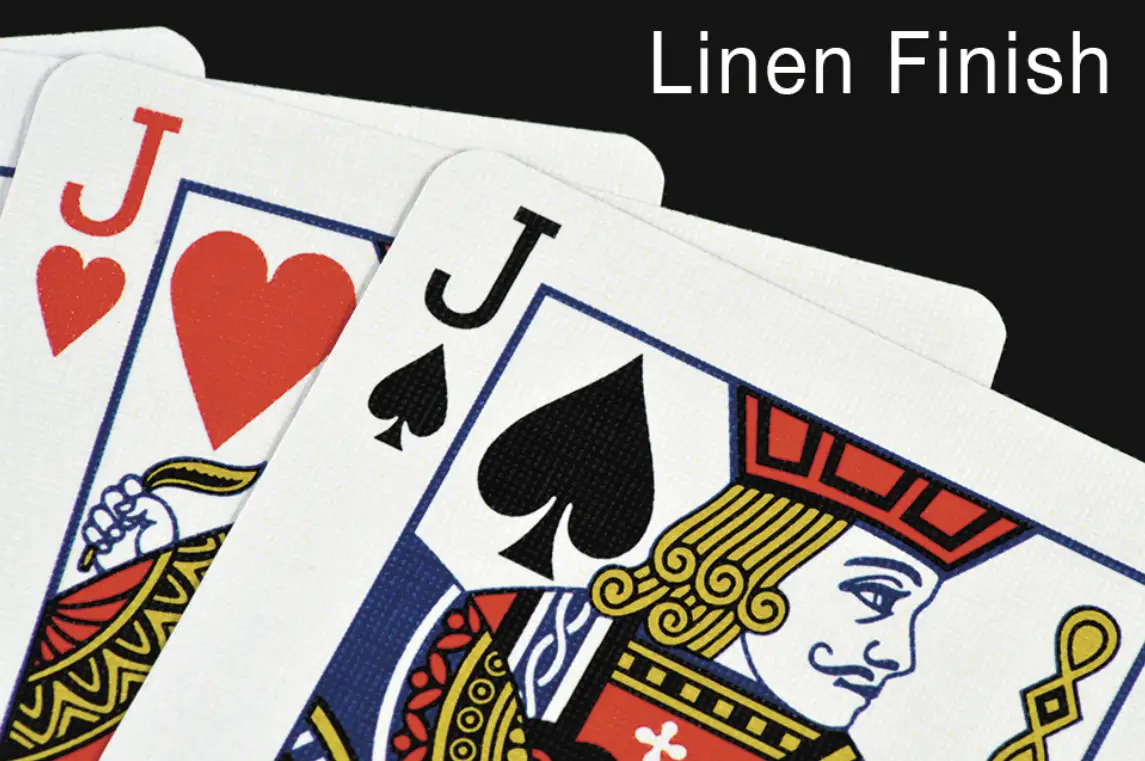
Benefits of Linen Finish
-
Enhanced Durability: The embossed texture helps reduce visible wear, making cards more resistant to scratches and creases.
-
Improved Handling: Ideal for sleight of hand and flourishes, the Linen finish offers a tactile grip without sticking.
-
Professional Look and Feel: That subtle texture creates a premium, sophisticated appearance that feels satisfying in the hand.
This finish is a favourite among professional magicians and cardists for its balance of control and fluidity. It’s also incredibly forgiving during fast-paced games, helping maintain crisp edges and clean surfaces even after extended use.
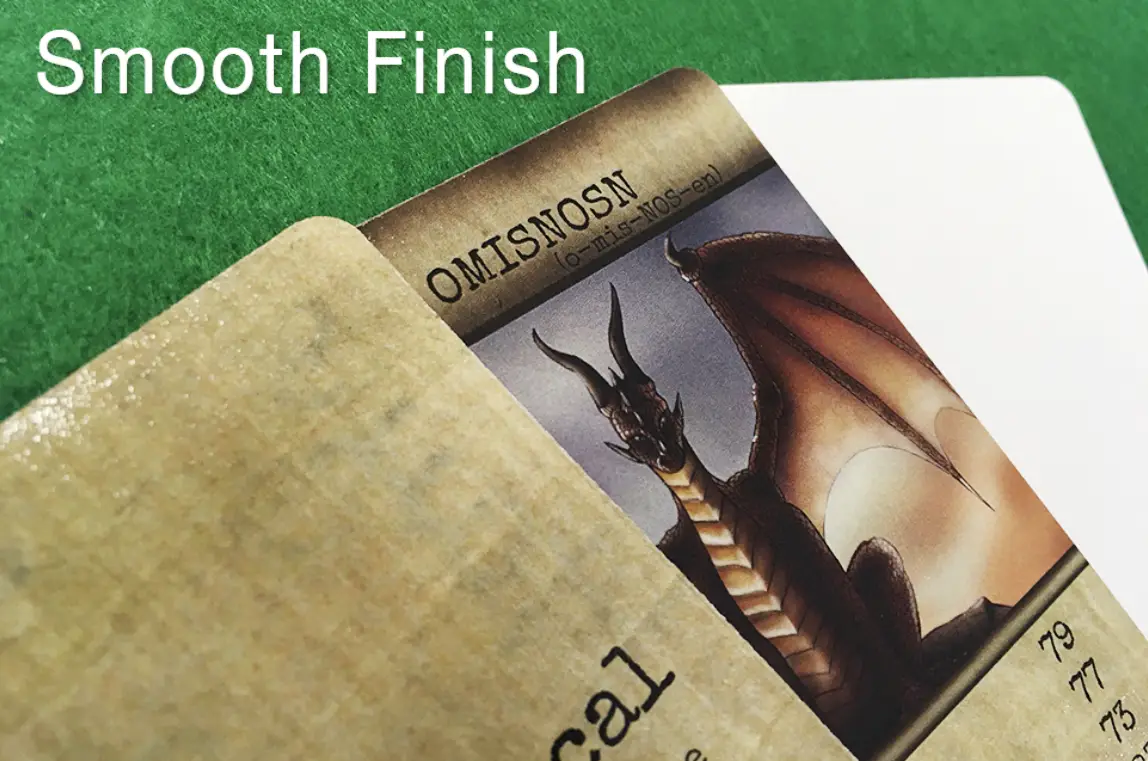
Benefits of Smooth Finish
-
Silky Shuffling: Smooth cards slide effortlessly, making for seamless overhand and riffle shuffles.
-
Vibrant Print Quality: With no surface embossing, artwork appears ultra-crisp and vivid, ideal for collectors or visually striking designs.
-
Long-Lasting Brilliance: The finish helps lock in colours, preventing fading or dulling over time.
Smooth finishes appeal to players and collectors alike who value a clean aesthetic and smooth handling. It provides a slick feel that’s both modern and classic.
8. Paper Stock & Finish
Common Choices
- Smooth finish: Clean look, softer handling
- Linen or textured finish: Improved grip, traditional feel
Consider:
-
How often the deck will be shuffled
-
Whether it’s for gameplay or display
Benefits of Linen Finish
-
Enhanced Durability: The embossed texture helps reduce visible wear, making cards more resistant to scratches and creases.
-
Improved Handling: Ideal for sleight of hand and flourishes, the Linen finish offers a tactile grip without sticking.
-
Professional Look and Feel: That subtle texture creates a premium, sophisticated appearance that feels satisfying in the hand.
This finish is a favourite among professional magicians and cardists for its balance of control and fluidity. It’s also incredibly forgiving during fast-paced games, helping maintain crisp edges and clean surfaces even after extended use.
Benefits of Smooth Finish
-
Silky Shuffling: Smooth cards slide effortlessly, making for seamless overhand and riffle shuffles.
-
Vibrant Print Quality: With no surface embossing, artwork appears ultra-crisp and vivid, ideal for collectors or visually striking designs.
-
Long-Lasting Brilliance: The finish helps lock in colours, preventing fading or dulling over time.
Smooth finishes appeal to players and collectors alike who value a clean aesthetic and smooth handling. It provides a slick feel that’s both modern and classic.
8. Paper Stock & Finish
Common Choices
- Smooth finish: Clean look, softer handling
- Linen or textured finish: Improved grip, traditional feel
Consider:
-
How often the deck will be shuffled
-
Whether it’s for gameplay or display
Benefits of Linen Finish
-
Enhanced Durability: The embossed texture helps reduce visible wear, making cards more resistant to scratches and creases.
-
Improved Handling: Ideal for sleight of hand and flourishes, the Linen finish offers a tactile grip without sticking.
-
Professional Look and Feel: That subtle texture creates a premium, sophisticated appearance that feels satisfying in the hand.
This finish is a favourite among professional magicians and cardists for its balance of control and fluidity. It’s also incredibly forgiving during fast-paced games, helping maintain crisp edges and clean surfaces even after extended use.
Benefits of Smooth Finish
-
Silky Shuffling: Smooth cards slide effortlessly, making for seamless overhand and riffle shuffles.
-
Vibrant Print Quality: With no surface embossing, artwork appears ultra-crisp and vivid, ideal for collectors or visually striking designs.
-
Long-Lasting Brilliance: The finish helps lock in colours, preventing fading or dulling over time.
Smooth finishes appeal to players and collectors alike who value a clean aesthetic and smooth handling. It provides a slick feel that’s both modern and classic.
9. Common Bridge Card Design Mistakes
- Treating bridge cards as resized poker cards
- Overcrowding narrow card faces
- Decorative but illegible indices
- Non-symmetrical card backs
- Ignoring traditional player expectations
Bridge players value consistency and function.
10. Who This Deck Type Is Best For
Bridge cards are ideal for:
-
Bridge clubs and tournaments
-
Educational decks for learning trick-taking games
-
Classic card game enthusiasts
-
Refined brand or heritage-style decks
For highly visual or symbolic projects, poker or tarot formats may be more suitable.
11. Ready to Print?
Once your bridge card design follows these guidelines, you’re well prepared for production.
Reviewing a digital proof or test print is strongly recommended, especially for index size and spacing.
9. Common Bridge Card Design Mistakes
- Treating bridge cards as resized poker cards
- Overcrowding narrow card faces
- Decorative but illegible indices
- Non-symmetrical card backs
- Ignoring traditional player expectations
Bridge players value consistency and function.
10. Who This Deck Type Is Best For
Bridge cards are ideal for:
-
Bridge clubs and tournaments
-
Educational decks for learning trick-taking games
-
Classic card game enthusiasts
-
Refined brand or heritage-style decks
For highly visual or symbolic projects, poker or tarot formats may be more suitable.
11. Ready to Print?
Once your bridge card design follows these guidelines, you’re well prepared for production.
Reviewing a digital proof or test print is strongly recommended, especially for index size and spacing.
9. Common Bridge Card Design Mistakes
- Treating bridge cards as resized poker cards
- Overcrowding narrow card faces
- Decorative but illegible indices
- Non-symmetrical card backs
- Ignoring traditional player expectations
Bridge players value consistency and function.
10. Who This Deck Type Is Best For
Bridge cards are ideal for:
-
Bridge clubs and tournaments
-
Educational decks for learning trick-taking games
-
Classic card game enthusiasts
-
Refined brand or heritage-style decks
For highly visual or symbolic projects, poker or tarot formats may be more suitable.
11. Ready to Print?
Once your bridge card design follows these guidelines, you’re well prepared for production.
Reviewing a digital proof or test print is strongly recommended, especially for index size and spacing.