
Double Poker Card Deck Design Guide
This guide is for creators designing double poker cards sized 89 × 127 mm. Double poker cards are oversized playing cards based on standard poker proportions, offering increased visibility while preserving traditional gameplay mechanics.
They are ideal when clarity and presence are needed without moving into jumbo or non-playable formats.
1. What are Double Poker Cards?
4. Layout & Proportions
7. File Setup & Print Req.
10. Double Poker Size Is Best For
2. Double Poker Card Specifications
5. Card Back Design
8. Paper Stock & Finish
11. Ready to Print?
3. Card Face Design
6. Colour Considerations
9. Common Design Mistakes

1. What are Double Poker Cards?
Double poker cards are enlarged versions of standard poker cards, designed to:
-
Improve readability of indices and suits
-
Support group or casual play environments
-
Enhance accessibility for players who benefit from larger visuals
-
Create novelty or premium-feel decks
They are commonly used in:
-
Home and casual game settings
-
Assisted or accessible play environments
-
Teaching and demonstration
-
Promotional or novelty decks
Despite their size, they are still intended to be played like poker cards.
2. Oracle Card Specifications
Card Size
Size: 89 × 127 mm (3.5″ x 5.0″) View Full Advanced Size Guide
This format:
-
Maintains poker card proportions
-
Offers significantly larger face area than standard poker cards
-
Improves legibility of ranks and suits
-
Allows slightly more breathing room for artwork
Cards can still be shuffled and dealt, though handling differs from standard decks.
Card Count
Most double poker decks follow standard poker structures:
-
52-card decks
-
Optional Jokers
-
Custom additions if required
Maintaining familiar card counts supports intuitive gameplay.
Double Poker Card Deck Design Guide
This guide is for creators designing double poker cards sized 89 × 127 mm. Double poker cards are oversized playing cards based on standard poker proportions, offering increased visibility while preserving traditional gameplay mechanics.
They are ideal when clarity and presence are needed without moving into jumbo or non-playable formats.
1. What are Double Poker Cards?
2. Double Poker Card Specifications
3. Card Face Design
4. Layout & Proportions
5. Card Back Design
6. Colour Considerations
7. File Setup & Print Req.
8. Paper Stock & Finish
9. Common Design Mistakes
10. Double Poker Size Is Best For
11. Ready to Print?
1. What are Double Poker Cards?
Double poker cards are enlarged versions of standard poker cards, designed to:
-
Improve readability of indices and suits
-
Support group or casual play environments
-
Enhance accessibility for players who benefit from larger visuals
-
Create novelty or premium-feel decks
They are commonly used in:
-
Home and casual game settings
-
Assisted or accessible play environments
-
Teaching and demonstration
-
Promotional or novelty decks
Despite their size, they are still intended to be played like poker cards.
2. Oracle Card Specifications
Card Size
Size: 89 × 127 mm (3.5″ x 5.0″) View Full Advanced Size Guide
This format:
-
Maintains poker card proportions
-
Offers significantly larger face area than standard poker cards
-
Improves legibility of ranks and suits
-
Allows slightly more breathing room for artwork
Cards can still be shuffled and dealt, though handling differs from standard decks.
Card Count
Most double poker decks follow standard poker structures:
-
52-card decks
-
Optional Jokers
-
Custom additions if required
Maintaining familiar card counts supports intuitive gameplay.
Double Poker Card Deck Design Guide
This guide is for creators designing double poker cards sized 89 × 127 mm. Double poker cards are oversized playing cards based on standard poker proportions, offering increased visibility while preserving traditional gameplay mechanics.
They are ideal when clarity and presence are needed without moving into jumbo or non-playable formats.
1. What are Double Poker Cards?
2. Double Poker Card Specifications
3. Card Face Design
4. Layout & Proportions
5. Card Back Design
6. Colour Considerations
7. File Setup & Print Req.
8. Paper Stock & Finish
9. Common Design Mistakes
10. Double Poker Size Is Best For
11. Ready to Print?
1. What are Double Poker Cards?
Double poker cards are enlarged versions of standard poker cards, designed to:
-
Improve readability of indices and suits
-
Support group or casual play environments
-
Enhance accessibility for players who benefit from larger visuals
-
Create novelty or premium-feel decks
They are commonly used in:
-
Home and casual game settings
-
Assisted or accessible play environments
-
Teaching and demonstration
-
Promotional or novelty decks
Despite their size, they are still intended to be played like poker cards.
2. Oracle Card Specifications
Card Size
Size: 89 × 127 mm (3.5″ x 5.0″) View Full Advanced Size Guide
This format:
-
Maintains poker card proportions
-
Offers significantly larger face area than standard poker cards
-
Improves legibility of ranks and suits
-
Allows slightly more breathing room for artwork
Cards can still be shuffled and dealt, though handling differs from standard decks.
Card Count
Most double poker decks follow standard poker structures:
-
52-card decks
-
Optional Jokers
-
Custom additions if required
Maintaining familiar card counts supports intuitive gameplay.
3. Card Face Design
Indices & Suits
Indices and suit symbols must remain instantly recognizable.
Best practices:
-
Increase index size proportionally
-
Preserve traditional placement (corners)
-
Avoid overly stylised suit shapes
Gameplay speed depends on recognition.
Artwork & Centre Design
The larger format allows:
-
More detailed central artwork
-
Stronger visual presence
-
Improved clarity for custom illustrations
However, artwork should never interfere with rank or suit visibility.
3. Card Face Design
Indices & Suits
Indices and suit symbols must remain instantly recognizable.
Best practices:
-
Increase index size proportionally
-
Preserve traditional placement (corners)
-
Avoid overly stylised suit shapes
Gameplay speed depends on recognition.
Artwork & Centre Design
The larger format allows:
-
More detailed central artwork
-
Stronger visual presence
-
Improved clarity for custom illustrations
However, artwork should never interfere with rank or suit visibility.
3. Card Face Design
Indices & Suits
Indices and suit symbols must remain instantly recognizable.
Best practices:
-
Increase index size proportionally
-
Preserve traditional placement (corners)
-
Avoid overly stylised suit shapes
Gameplay speed depends on recognition.
Artwork & Centre Design
The larger format allows:
-
More detailed central artwork
-
Stronger visual presence
-
Improved clarity for custom illustrations
However, artwork should never interfere with rank or suit visibility.
4. Layout & Proportions
Double poker cards should scale up, not redesign, poker layouts.
Guidelines:
-
Keep traditional margins and spacing
-
Maintain symmetry and balance
-
Avoid filling space just because it exists
Familiarity is a feature, not a limitation.
5. Card Back Design
Orientation
Poker-style decks typically use two-way (rotationally symmetric) backs.
Design considerations:
-
Ensure the back reveals no orientation cues
-
Maintain symmetry across both axes
-
Test for visual balance at larger scale
This preserves fairness during play.
Back Detail
Larger backs can support:
-
Slightly more detailed patterns
-
Subtle textures or line work
Avoid extreme contrast or visual noise.
4. Layout & Proportions
Double poker cards should scale up, not redesign, poker layouts.
Guidelines:
-
Keep traditional margins and spacing
-
Maintain symmetry and balance
-
Avoid filling space just because it exists
Familiarity is a feature, not a limitation.
5. Card Back Design
Orientation
Poker-style decks typically use two-way (rotationally symmetric) backs.
Design considerations:
-
Ensure the back reveals no orientation cues
-
Maintain symmetry across both axes
-
Test for visual balance at larger scale
This preserves fairness during play.
Back Detail
Larger backs can support:
-
Slightly more detailed patterns
-
Subtle textures or line work
Avoid extreme contrast or visual noise.
4. Layout & Proportions
Double poker cards should scale up, not redesign, poker layouts.
Guidelines:
-
Keep traditional margins and spacing
-
Maintain symmetry and balance
-
Avoid filling space just because it exists
Familiarity is a feature, not a limitation.
5. Card Back Design
Orientation
Poker-style decks typically use two-way (rotationally symmetric) backs.
Design considerations:
-
Ensure the back reveals no orientation cues
-
Maintain symmetry across both axes
-
Test for visual balance at larger scale
This preserves fairness during play.
Back Detail
Larger backs can support:
-
Slightly more detailed patterns
-
Subtle textures or line work
Avoid extreme contrast or visual noise.
6. Colour Considerations
-
Maintain high contrast for red/black suits
-
Avoid color combinations that obscure suit identity
-
Test fine line work at full size
Larger cards make print inconsistencies more visible.
7. File Setup & Print Requirements
Bleed
-
Include bleed on all sides (3mm) – View Full Advanced Card Size Guide
-
Extend background elements fully into bleed
Never place:
-
Indices
-
Suit symbols
-
Borders
near the trim edge.
Safe Zone
Because of the increased size, safe zones should be generous, especially for corner indices.
Resolution & Colour Mode
-
Minimum 300 DPI
-
CMYK colour mode
Always proof printed cards before full production.
6. Colour Considerations
-
Maintain high contrast for red/black suits
-
Avoid color combinations that obscure suit identity
-
Test fine line work at full size
Larger cards make print inconsistencies more visible.
7. File Setup & Print Requirements
Bleed
-
Include bleed on all sides (3mm) – View Full Advanced Card Size Guide
-
Extend background elements fully into bleed
Never place:
-
Indices
-
Suit symbols
-
Borders
near the trim edge.
Safe Zone
Because of the increased size, safe zones should be generous, especially for corner indices.
Resolution & Colour Mode
-
Minimum 300 DPI
-
CMYK colour mode
Always proof printed cards before full production.
6. Colour Considerations
-
Maintain high contrast for red/black suits
-
Avoid color combinations that obscure suit identity
-
Test fine line work at full size
Larger cards make print inconsistencies more visible.
7. File Setup & Print Requirements
Bleed
-
Include bleed on all sides (3mm) – View Full Advanced Card Size Guide
-
Extend background elements fully into bleed
Never place:
-
Indices
-
Suit symbols
-
Borders
near the trim edge.
Safe Zone
Because of the increased size, safe zones should be generous, especially for corner indices.
Resolution & Colour Mode
-
Minimum 300 DPI
-
CMYK colour mode
Always proof printed cards before full production.
8. Paper Stock & Finish
Common Choices
- Smooth finish: Clean look, softer handling
- Linen or textured finish: Improved grip, traditional feel
Consider:
Handling comfort matters more with larger cards.
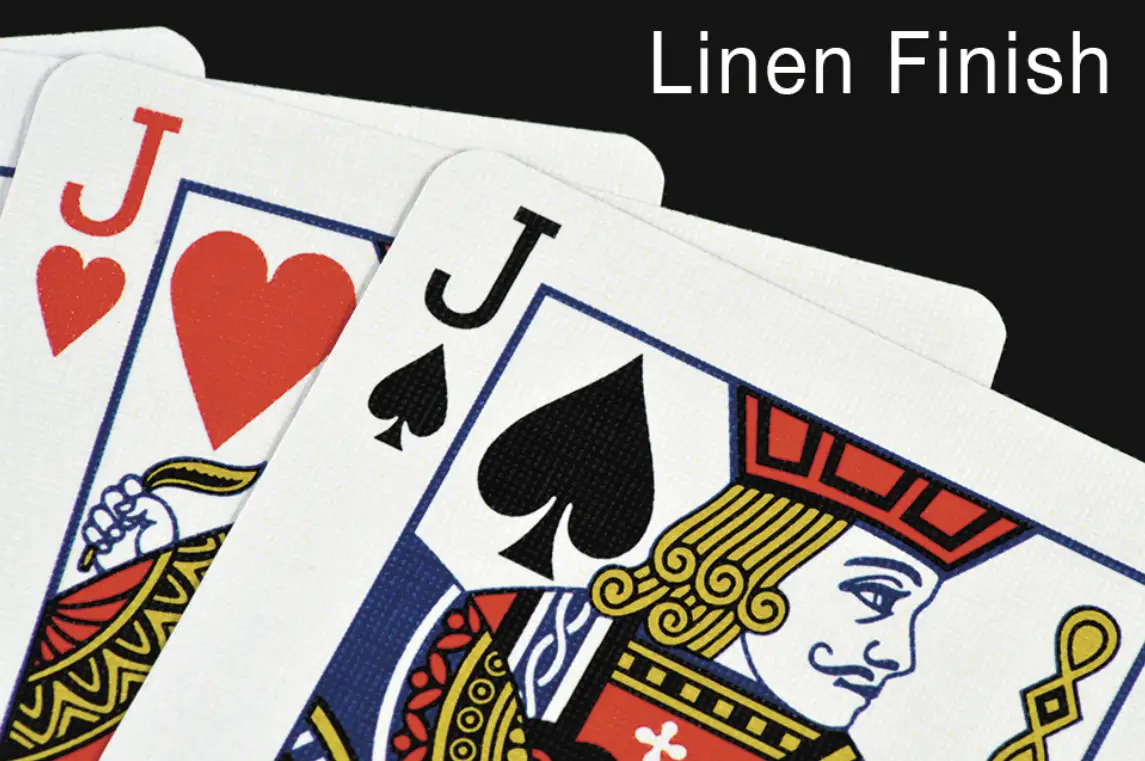
Benefits of Linen Finish
-
Enhanced Durability: The embossed texture helps reduce visible wear, making cards more resistant to scratches and creases.
-
Improved Handling: Ideal for sleight of hand and flourishes, the Linen finish offers a tactile grip without sticking.
-
Professional Look and Feel: That subtle texture creates a premium, sophisticated appearance that feels satisfying in the hand.
This finish is a favourite among professional magicians and cardists for its balance of control and fluidity. It’s also incredibly forgiving during fast-paced games, helping maintain crisp edges and clean surfaces even after extended use.
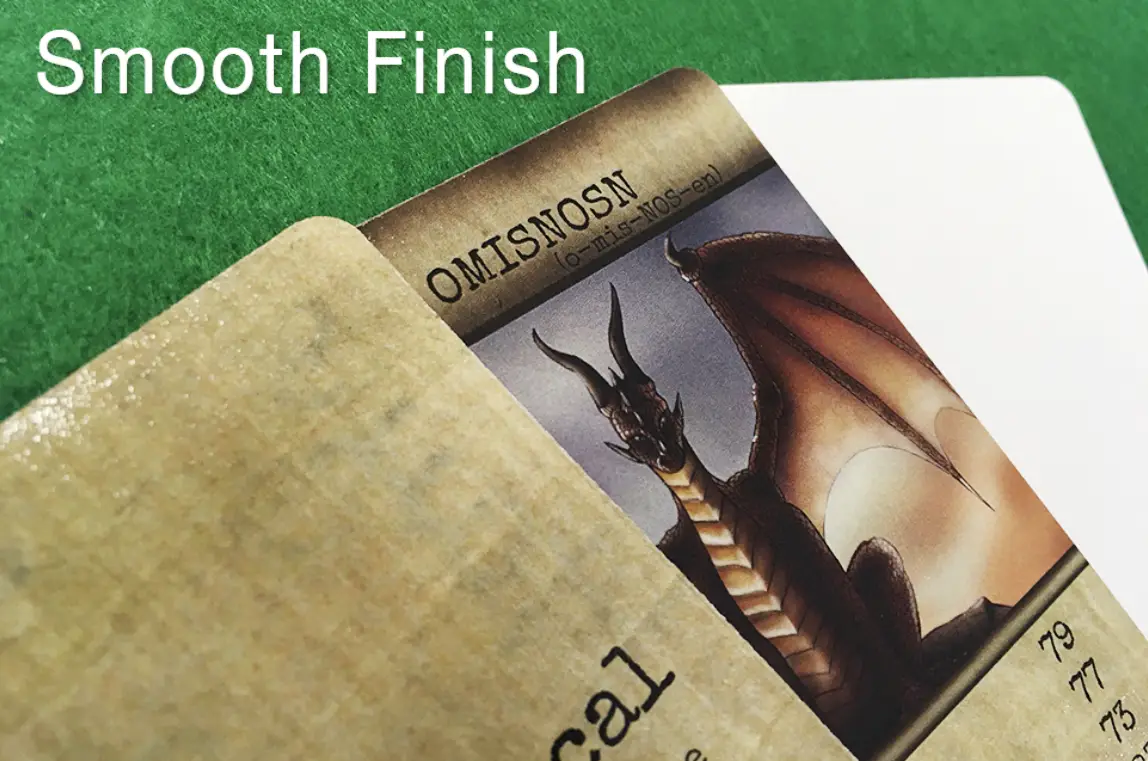
Benefits of Smooth Finish
-
Silky Shuffling: Smooth cards slide effortlessly, making for seamless overhand and riffle shuffles.
-
Vibrant Print Quality: With no surface embossing, artwork appears ultra-crisp and vivid, ideal for collectors or visually striking designs.
-
Long-Lasting Brilliance: The finish helps lock in colours, preventing fading or dulling over time.
Smooth finishes appeal to players and collectors alike who value a clean aesthetic and smooth handling. It provides a slick feel that’s both modern and classic.
8. Paper Stock & Finish
Common Choices
- Smooth finish: Clean look, softer handling
- Linen or textured finish: Improved grip, traditional feel
Consider:
Handling comfort matters more with larger cards.
Benefits of Linen Finish
-
Enhanced Durability: The embossed texture helps reduce visible wear, making cards more resistant to scratches and creases.
-
Improved Handling: Ideal for sleight of hand and flourishes, the Linen finish offers a tactile grip without sticking.
-
Professional Look and Feel: That subtle texture creates a premium, sophisticated appearance that feels satisfying in the hand.
This finish is a favourite among professional magicians and cardists for its balance of control and fluidity. It’s also incredibly forgiving during fast-paced games, helping maintain crisp edges and clean surfaces even after extended use.
Benefits of Smooth Finish
-
Silky Shuffling: Smooth cards slide effortlessly, making for seamless overhand and riffle shuffles.
-
Vibrant Print Quality: With no surface embossing, artwork appears ultra-crisp and vivid, ideal for collectors or visually striking designs.
-
Long-Lasting Brilliance: The finish helps lock in colours, preventing fading or dulling over time.
Smooth finishes appeal to players and collectors alike who value a clean aesthetic and smooth handling. It provides a slick feel that’s both modern and classic.
8. Paper Stock & Finish
Common Choices
- Smooth finish: Clean look, softer handling
- Linen or textured finish: Improved grip, traditional feel
Consider:
Handling comfort matters more with larger cards.
Benefits of Linen Finish
-
Enhanced Durability: The embossed texture helps reduce visible wear, making cards more resistant to scratches and creases.
-
Improved Handling: Ideal for sleight of hand and flourishes, the Linen finish offers a tactile grip without sticking.
-
Professional Look and Feel: That subtle texture creates a premium, sophisticated appearance that feels satisfying in the hand.
This finish is a favourite among professional magicians and cardists for its balance of control and fluidity. It’s also incredibly forgiving during fast-paced games, helping maintain crisp edges and clean surfaces even after extended use.
Benefits of Smooth Finish
-
Silky Shuffling: Smooth cards slide effortlessly, making for seamless overhand and riffle shuffles.
-
Vibrant Print Quality: With no surface embossing, artwork appears ultra-crisp and vivid, ideal for collectors or visually striking designs.
-
Long-Lasting Brilliance: The finish helps lock in colours, preventing fading or dulling over time.
Smooth finishes appeal to players and collectors alike who value a clean aesthetic and smooth handling. It provides a slick feel that’s both modern and classic.
9. Common Double Poker Card Design Mistakes
-
Overcomplicating indices or suits
-
Treating the format like a jumbo display card
-
Adding decorative elements that reduce readability
-
Ignoring shuffle ergonomics
-
Breaking traditional poker proportions
Playability should always come first.
10. Who This Deck Type Is Best For
Double poker cards are ideal for:
-
Casual and social card players
-
Teaching card games
-
Accessible or senior-friendly decks
-
Novelty or premium card products
If your project prioritises portability or competitive play, standard poker cards may be more suitable.
11. Ready to Print?
Once your double poker card design preserves clarity, familiarity and playability at scale, you’re ready to move to production.
Test shuffling, dealing and gameplay with printed samples before final approval.
9. Common Double Poker Card Design Mistakes
-
Overcomplicating indices or suits
-
Treating the format like a jumbo display card
-
Adding decorative elements that reduce readability
-
Ignoring shuffle ergonomics
-
Breaking traditional poker proportions
Playability should always come first.
10. Who This Deck Type Is Best For
Double poker cards are ideal for:
-
Casual and social card players
-
Teaching card games
-
Accessible or senior-friendly decks
-
Novelty or premium card products
If your project prioritises portability or competitive play, standard poker cards may be more suitable.
11. Ready to Print?
Once your double poker card design preserves clarity, familiarity and playability at scale, you’re ready to move to production.
Test shuffling, dealing and gameplay with printed samples before final approval.
9. Common Double Poker Card Design Mistakes
-
Overcomplicating indices or suits
-
Treating the format like a jumbo display card
-
Adding decorative elements that reduce readability
-
Ignoring shuffle ergonomics
-
Breaking traditional poker proportions
Playability should always come first.
10. Who This Deck Type Is Best For
Double poker cards are ideal for:
-
Casual and social card players
-
Teaching card games
-
Accessible or senior-friendly decks
-
Novelty or premium card products
If your project prioritises portability or competitive play, standard poker cards may be more suitable.
11. Ready to Print?
Once your double poker card design preserves clarity, familiarity and playability at scale, you’re ready to move to production.
Test shuffling, dealing and gameplay with printed samples before final approval.